GHK-Cu for Hair Growth: Copper Peptide Evidence and Limits
GHK-Cu for hair growth explained: copper peptide mechanism, topical evidence, hair-follicle studies, delivery limits, safety and how it compares with minoxidil.
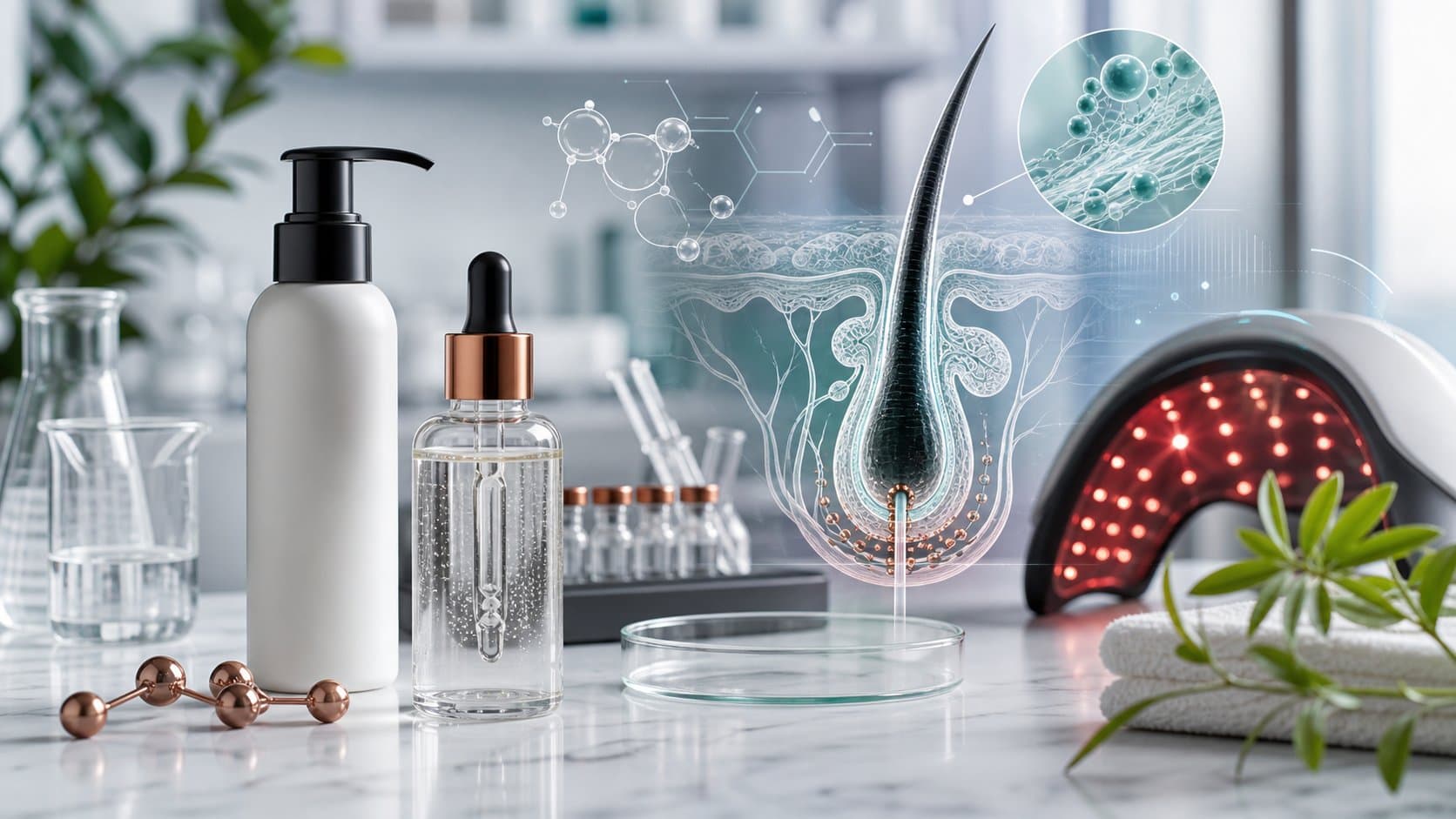
GHK-Cu is one of the few peptides with a reasonable topical story for hair: it is a copper-binding tripeptide connected to skin remodeling, wound repair, dermal papilla biology and cosmetic scalp formulas.
The key limitation: GHK-Cu has ingredient-level and preclinical support, not the same level of hair-loss evidence as minoxidil or finasteride.
For the broader stack, see the hub: best peptides for hair growth.
What GHK-Cu Is
GHK-Cu stands for glycyl-L-histidyl-L-lysine copper complex. In cosmetic ingredient lists, it often appears as copper tripeptide-1. It is used in skin and scalp products because copper peptides are tied to repair signaling, extracellular matrix remodeling and antioxidant/anti-inflammatory biology.
| Question | Answer |
|---|---|
| Best use case | Topical scalp support and cosmetic hair-density routines. |
| Best evidence type | Ex vivo hair follicle work, cell studies, skin/wound-healing research and delivery research. |
| Weakest claim | That GHK-Cu alone is a proven replacement for minoxidil, finasteride or dutasteride. |
| Practical read | Interesting adjunct ingredient; not a standalone medical hair-loss treatment. |
How It Might Help Hair
Hair follicles are not just strands of keratin. They sit in a living scalp environment involving dermal papilla cells, inflammation, extracellular matrix, blood supply and growth-cycle signaling.
GHK-Cu is relevant because studies connect copper peptide complexes to:
- Dermal papilla cell proliferation
- Hair follicle elongation in ex vivo models
- Wound repair and remodeling pathways
- Antioxidant and anti-inflammatory signaling
- Skin penetration and delivery questions
That gives GHK-Cu a plausible role in a hair protocol, especially as a topical adjunct. It does not prove that any random injectable or cosmetic product will regrow hair.
Evidence Map
| Evidence | What it suggests | Limit |
|---|---|---|
| Human hair follicles ex vivo / dermal papilla cells | AHK-Cu stimulated follicle elongation and dermal papilla cell proliferation in a lab model. | Not a clinical trial in people applying a finished product. |
| GHK skin regeneration reviews | GHK-Cu has repair, remodeling, antioxidant and anti-inflammatory rationale. | Skin remodeling evidence does not automatically equal hair regrowth. |
| Topical delivery papers | Delivery is a real challenge; formulation matters. | Ingredient presence on a label does not prove scalp delivery. |
| Hair-loss medication evidence | Minoxidil/finasteride have stronger human outcome evidence. | GHK-Cu is better viewed as adjunctive unless future trials show otherwise. |
Topical vs Injectable GHK-Cu
For hair, topical use makes the most sense because the target is the scalp and hair follicle environment. Injectable GHK-Cu is often discussed in peptide communities, but that does not mean it has better hair-growth evidence.
Topical products still have a major variable: delivery. A copper peptide has to reach the right scalp layer at a useful concentration without irritating the skin. That is why formulation matters as much as the ingredient name.
Where It Fits in a Hair Protocol
GHK-Cu is best positioned as a support layer:
- Keep proven medical therapy separate: minoxidil, finasteride or dutasteride decisions belong with a clinician.
- Use copper peptides as a scalp-support adjunct, not a replacement.
- Track photos monthly, not daily.
- Stop if irritation, burning, rash or unusual shedding appears.
For the broader stack, see the Bryan Johnson hair protocol and the GHK-Cu database entry.
FAQ
Does GHK-Cu regrow hair?
GHK-Cu has lab and ingredient-level evidence that supports a hair-growth rationale, but it is not proven like minoxidil or finasteride for androgenetic alopecia.
Is copper tripeptide-1 the same as GHK-Cu?
Copper tripeptide-1 is the cosmetic ingredient name commonly used for GHK-Cu or closely related copper peptide complexes.
Is topical GHK-Cu better than injectable GHK-Cu for hair?
For hair-specific use, topical is the more logical route because the scalp is the target. Injectable use does not have stronger clinical hair-growth evidence.
Can GHK-Cu be used with minoxidil?
Many routines layer scalp-support products around minoxidil, but irritation and timing matter. Let minoxidil dry and avoid combining multiple irritating actives at once.
References
Pyo HK, et al. Tripeptide-copper complex and human hair growth in vitro.
Pickart L, Vasquez-Soltero JM, Margolina A. GHK peptide as a modulator of skin regeneration pathways.
Pickart L, Margolina A. The potential of GHK as an anti-aging peptide.
Zhang Y, et al. GHK-Cu topical delivery and hair-loss application paper.
Hostynek JJ, et al. Human skin penetration of a copper tripeptide in vitro.