Sermorelin: Complete Guide to the GH-Releasing Peptide (2026)
Sermorelin is a synthetic GHRH analog used to raise human growth hormone levels. Here's what it is, what it does, how it's dosed, side effects, legal status — and what it isn't.
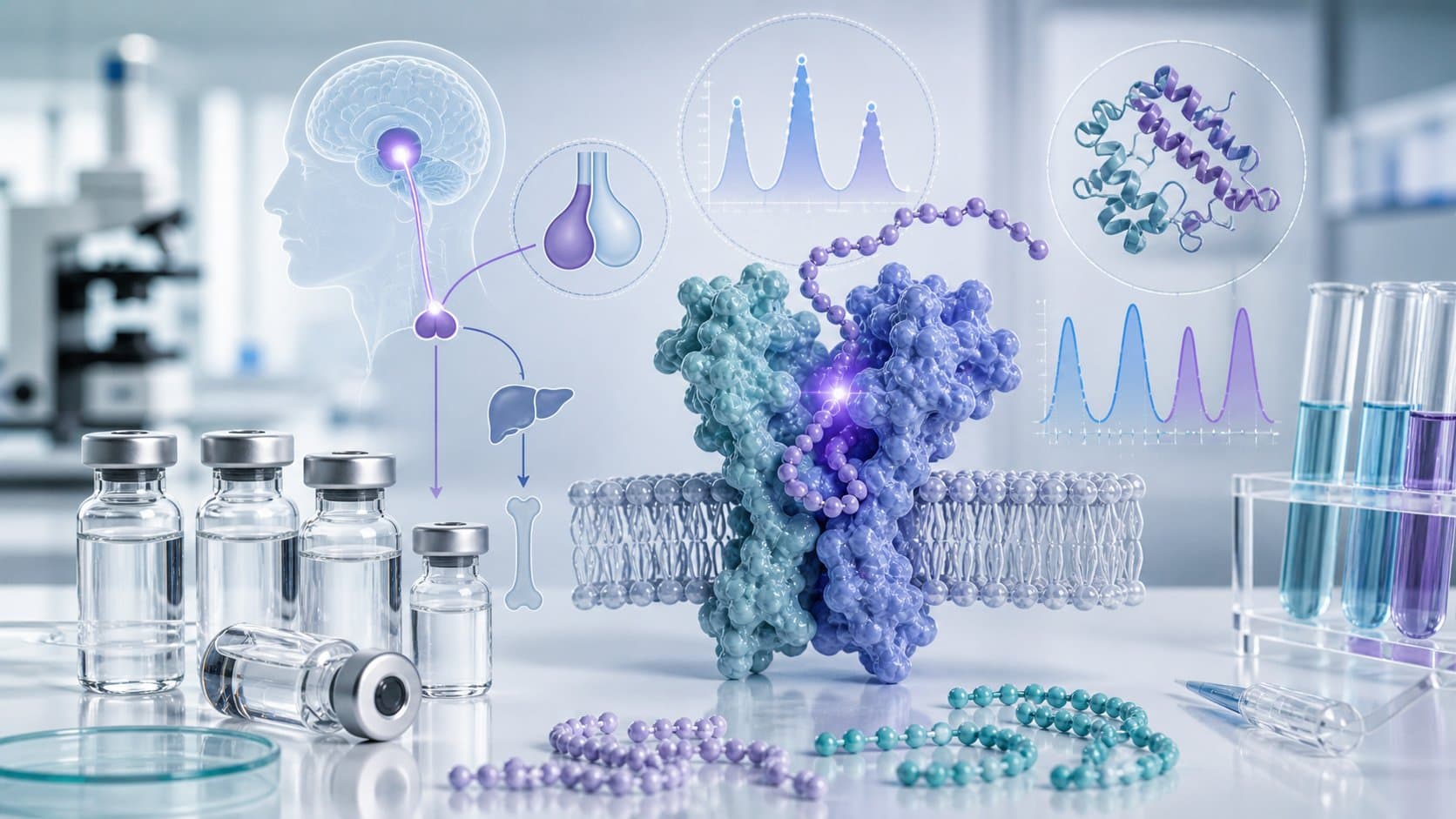
Sermorelin shows up in searches alongside GLP-1 drugs but it's a completely different class. Where GLP-1 receptor agonists target appetite and metabolic signaling, sermorelin targets the pituitary gland's release of human growth hormone (hGH). It's a growth-hormone-releasing hormone (GHRH) analog — a synthetic version of the natural hormone that prompts the pituitary to release its own GH.
This is the full guide to sermorelin: mechanism, uses, dosing, side effects, and where it stands legally in 2026.
What sermorelin is
| Aspect | Detail | | --- | --- | | Generic name | Sermorelin (also called GRF 1-29) | | Class | GHRH analog / GH secretagogue | | Original brands | Geref, Gerel (both withdrawn) | | Form | Subcutaneous injection (lyophilized powder for reconstitution) | | Typical dose | 200-500 mcg/day at bedtime | | FDA status | Discontinued as a manufactured product. Available via compounding pharmacies. |
Sermorelin is a synthetic 29-amino-acid peptide — specifically, the biologically active first 29 amino acids of the human GHRH molecule. That's the active core of the natural hormone.
How sermorelin works
The body's growth hormone (hGH) system:
- Hypothalamus secretes GHRH (growth-hormone-releasing hormone)
- GHRH binds receptors on the pituitary gland
- Pituitary releases hGH into the bloodstream
- hGH stimulates IGF-1 production in the liver
- IGF-1 mediates most of GH's effects on tissues
Sermorelin mimics GHRH at step 2 — it binds the same receptors and prompts the pituitary to release hGH. The release is pulsatile, mimicking natural GH release patterns, rather than a continuous elevated GH level (which is what synthetic hGH injections produce).
This is different from direct hGH injection (e.g., somatropin): sermorelin works upstream, stimulating natural production. Direct hGH bypasses the pituitary entirely.
What sermorelin was originally approved for
Sermorelin was originally approved by the FDA in 1997 to:
- Diagnose atypical growth in children (GHRH stimulation test)
- Treat growth hormone deficiency in children
The original manufacturer removed sermorelin from the US market in 2008, not for safety or efficacy reasons but because higher doses were needed for effective pediatric treatment and competing alternatives (direct hGH injection) had become more effective for that indication.
It's still listed as "discontinued" by the FDA, but a manufacturer could re-apply for FDA approval via an abbreviated drug application since it was previously approved.
Where sermorelin is used now
Since the original brand-name product is no longer manufactured in the US, sermorelin in 2026 comes almost exclusively from compounding pharmacies — US-licensed 503A pharmacies preparing it for individual patient prescriptions.
Off-label use cases (none FDA-approved):
- Adult growth-hormone deficiency — diagnosed clinically
- Anti-aging / longevity — restoring GH/IGF-1 toward youthful levels
- Sleep quality — leveraging the GH-sleep relationship
- Body composition — modest fat loss and muscle preservation effects
- Recovery and athletic performance — improving sleep-related recovery
The off-label and compounded nature means quality and outcomes vary significantly between providers and pharmacies.
How sermorelin is dosed
Standard ranges for adult use (from compounding pharmacy protocols and clinical practice):
- Starting dose: 200-300 mcg daily
- Typical maintenance: 300-500 mcg daily
- Maximum commonly used: 500-1000 mcg daily
- Timing: Bedtime — aligns with the natural nocturnal GH pulse (within 30-60 minutes of sleep)
- Route: Subcutaneous injection (abdomen, thigh)
- Storage: Refrigerate reconstituted product; discard after ~30 days
Why bedtime: the body's largest natural GH pulses occur during slow- wave (deep) sleep. Injecting sermorelin before sleep amplifies the pituitary's response during this natural pulse.
Dose individualization: prescribers adjust based on:
- IGF-1 lab levels (the practical marker for GH activity)
- Patient symptoms and goals
- Age, body weight, baseline GH/IGF-1
- Side effects
What sermorelin produces
In clinical use, sermorelin tends to produce:
- Increased IGF-1 levels within 4-8 weeks (the lab proof of effect)
- Improved sleep quality for many patients — often the earliest reported change
- Modest fat loss, especially visceral fat
- Modest muscle / strength preservation with resistance training
- Skin and hair quality improvements reported anecdotally
- Energy improvements in some patients
What sermorelin does NOT typically produce:
- Dramatic muscle gain (that's the synthetic hGH territory, with much larger risks)
- Significant weight loss like GLP-1s
- Reduction of "food noise"
- Rapid body recomposition
The effects are subtle. Patients on sermorelin generally describe it as "feeling more like themselves" rather than dramatic transformation.
Side effects
Sermorelin is generally well-tolerated at clinical doses:
- Common: Injection-site reactions, flushing, mild headache
- Less common: Dizziness, dry mouth, sleep disruption, water retention
- Rare but possible: Joint pain (with elevated IGF-1), insulin resistance with chronic high-dose use, mild glucose elevation
Long-term risks of GH-pathway stimulation include:
- Theoretical cancer-promotion risk (relevant to anyone with cancer history)
- Insulin resistance with sustained high IGF-1
- Joint pain at sustained elevated GH/IGF-1
The dosing approach with sermorelin — pulsatile stimulation rather than sustained elevation — likely mitigates some of these risks vs direct hGH. But long-term human data is limited.
Sermorelin vs GLP-1s (the search-engine confusion)
These come up in the same searches, but they're not similar:
| | Sermorelin | GLP-1 receptor agonists | | --- | --- | --- | | Class | GHRH analog (GH stimulator) | GLP-1 receptor agonist | | Primary effect | Increases GH/IGF-1 | Suppresses appetite | | FDA approval | Discontinued (compounded use only) | Multiple approved drugs | | Primary use | Anti-aging, GH deficiency | Weight loss, T2D | | Weight loss effect | Modest at best | 8-21% of body weight | | Dosing | Daily SC injection | Weekly SC injection (most) or oral | | Cost (compounded) | $100-$300/month | $199-$349/month |
Searching for "sermorelin" usually means anti-aging / GH-related interest, not weight loss. Searching for "GLP-1" usually means weight loss / diabetes. The two intersect only in the broader category of "injectable peptides for metabolic and body composition effects."
Legal status in 2026
- Brand-name FDA approval: Discontinued since 2008
- Compounded form (503A pharmacy): Legal as patient-specific compounding when prescribed by a US-licensed physician
- Research peptide vials sold as "not for human consumption": Not pharmaceuticals; not a legal route for clinical use
The compounded route is the only legitimate path to sermorelin in the US in 2026.
When sermorelin makes sense
Reasonable candidates:
- Adults with documented growth hormone deficiency (a clinical diagnosis, not just feeling tired)
- Adults with low IGF-1 on labs who don't want or qualify for direct hGH injection
- Adults seeking modest anti-aging effects who understand the trade-offs
When sermorelin doesn't make sense:
- Anyone with active or recent cancer
- Anyone with diabetes mellitus (the GH/insulin resistance interaction matters)
- People expecting GLP-1-style weight loss (wrong drug)
- People expecting bodybuilder-level muscle gain (wrong drug; the alternative — direct hGH — has bigger risks)
FAQ
Is sermorelin a GLP-1? No. Sermorelin is a GHRH (growth-hormone-releasing hormone) analog. It stimulates growth hormone release. GLP-1s mimic an intestinal hormone for appetite and glucose control. Different drugs entirely.
Is sermorelin FDA-approved? The brand-name product was approved 1997 but discontinued by the manufacturer in 2008. Compounded sermorelin is available via 503A pharmacies under physician prescription.
Does sermorelin help with weight loss? Modest visceral fat loss is reported with sustained use, but the effect is much smaller than what GLP-1 drugs produce.
How much does sermorelin cost? Compounded sermorelin typically runs $100-$300/month depending on dose and pharmacy.
Can I buy sermorelin without a prescription? Not legally. "Research peptide" vials sold without prescription are outside the legal pharmaceutical system.
Is sermorelin the same as hGH? No. Sermorelin causes your own body to release more hGH. Direct hGH injection is the synthetic hormone itself.
When should sermorelin be injected? At bedtime — usually 30-60 minutes before sleep — to align with the natural nocturnal growth hormone pulse.
What's a good IGF-1 level on sermorelin? Most prescribers aim for IGF-1 in the upper half of the age-adjusted reference range, not above it. Specific targets are individual.
This article is for educational purposes only and is not medical advice. Sermorelin is a prescription medication when compounded. Discuss treatment with a qualified healthcare professional.