The GLP-1 Hormone: How It Works in Your Body (And How to Boost It Naturally)
GLP-1 is a hormone your gut releases after eating. Here's the biology — where it's made, what it does, why endogenous GLP-1 is short-lived, and which foods and habits boost it naturally.
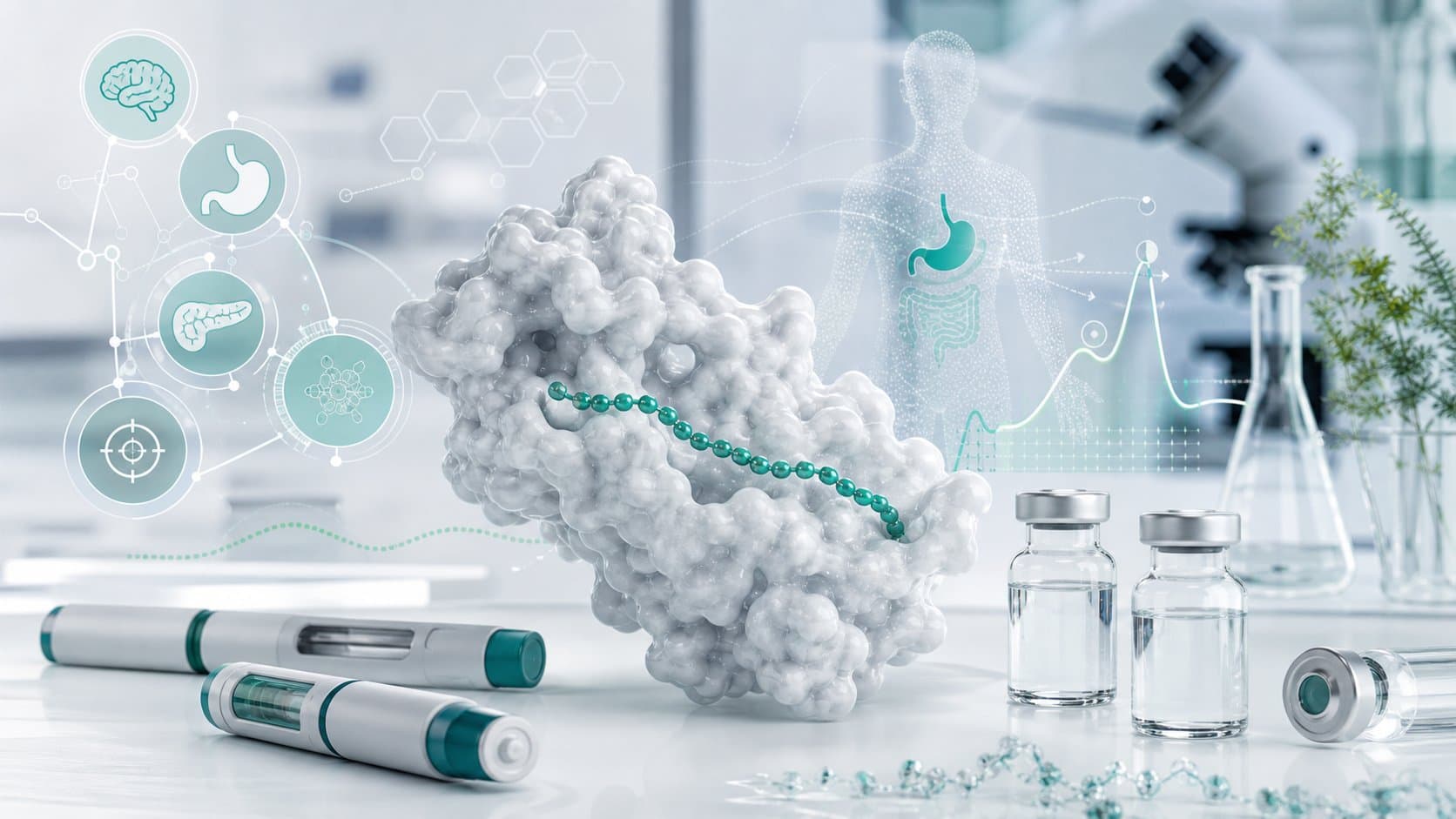
Before "GLP-1" became shorthand for the drug class, it was a hormone your body has been making your whole life. Understanding the hormone itself — where it comes from, what it does, and why your body breaks it down so fast — explains why GLP-1 receptor agonist drugs work the way they do.
What GLP-1 is, technically
GLP-1 (glucagon-like peptide-1) is a 30- or 31-amino-acid peptide hormone derived from the proglucagon gene. The same gene also produces glucagon (the hormone that raises blood sugar), GLP-2 (involved in gut growth), and several other peptides.
Two biologically active forms:
- GLP-1 (7–36) amide — the dominant circulating form (>80% in humans)
- GLP-1 (7–37) — equally potent, less abundant
The "7" reflects the position in the precursor peptide where cleavage makes the molecule active. Both forms bind the GLP-1 receptor with similar effects.
Where it's made
Two main sites:
- Intestinal L-cells — primarily in the distal ileum and colon, with some in the jejunum and duodenum. These are the main source.
- Brainstem neurons — in the nucleus of the solitary tract. Provide central nervous system GLP-1 effects.
L-cells are open-type cells directly exposed to gut lumen contents. They release GLP-1 into the hepatic portal system in response to multiple stimuli: nutrients, neural signaling, hormones from other gut cells.
When it's released
GLP-1 secretion follows a biphasic pattern:
- Early phase, 10-15 minutes after eating — likely driven by neural signaling and gut peptides anticipating the meal
- Later phase, 30-60 minutes after eating — driven directly by nutrients reaching the L-cells in the distal small intestine
Different foods produce different GLP-1 responses. Protein, fat, and soluble fiber tend to produce the strongest releases. Highly processed carbohydrates produce shorter-lived releases.
What GLP-1 does — the five effects
1. Glucose-dependent insulin secretion
GLP-1 binds receptors on pancreatic beta cells, increasing insulin release. Critically, this only happens when blood glucose is rising — so it doesn't cause hypoglycemia on its own. This is the incretin effect that defines GLP-1 alongside GIP.
2. Glucagon suppression
GLP-1 reduces glucagon secretion from pancreatic alpha cells, limiting the liver's release of stored glucose. Net effect: lower blood sugar.
3. Slowed gastric emptying
GLP-1 receptors in the GI tract slow how quickly food leaves the stomach. This:
- Extends satiety
- Reduces the post-meal glucose spike
- Causes the "I'm still full" feeling hours after eating
4. Central appetite suppression
GLP-1 receptors in the hypothalamus and brainstem reduce hunger signaling and quiet "food noise" — the intrusive thoughts about food. This is the effect drug developers exploited for weight management.
5. Various downstream protective effects
GLP-1 receptor activation is also linked to:
- Cardioprotective effects (endothelial function, anti-inflammatory)
- Reduced apoptosis of beta cells (preserves insulin-producing capacity)
- Neuroprotection (under study for Alzheimer's, Parkinson's)
- Renal effects
Why endogenous GLP-1 is so short-lived
Natural GLP-1 has a half-life of about two minutes. It's broken down primarily by:
- DPP-4 (dipeptidyl peptidase-4) — the dominant enzyme, cleaves GLP-1 at its N-terminus
- NEP 24.11 (neutral endopeptidase) — secondary
- Renal clearance — kidneys filter what's left
Only 10-15% of secreted GLP-1 reaches systemic circulation intact. This is why your body's natural GLP-1 — even after a big meal — produces much smaller effects than a once-weekly injection.
How drug developers extended GLP-1's life
Several pharmacological tricks turn a 2-minute hormone into a 7-day drug:
- Substitute amino acids near DPP-4's cut site (semaglutide does this)
- Attach a fatty acid chain that lets the drug bind albumin in blood, slowing clearance (semaglutide, liraglutide, tirzepatide)
- Build it as a fusion protein with IgG-Fc to slow clearance (dulaglutide)
- Engineer a small molecule that binds the same receptor with pill-friendly pharmacokinetics (orforglipron)
The result: drugs that last 12 hours to 7 days, producing sustained GLP-1 receptor activation that simulates "always just ate" signaling.
DPP-4 inhibitors — a different way to boost GLP-1
Rather than mimicking GLP-1, DPP-4 inhibitors (sitagliptin / Januvia, linagliptin / Tradjenta, alogliptin, saxagliptin) block the enzyme that destroys it — boosting your own GLP-1 levels modestly.
- Effect on A1c: 0.5-1.0 point reduction
- Effect on weight: neutral (much less powerful than GLP-1 receptor agonists)
- Effect on appetite: minimal — endogenous GLP-1 boosted to physiological levels, not pharmacological
DPP-4 inhibitors are generally less potent than GLP-1 RAs because they're working with the body's natural GLP-1 supply, not adding a durable pharmacological agonist on top.
How to boost GLP-1 naturally
You can't naturally hit GLP-1 levels comparable to a weekly Wegovy injection, but lifestyle factors meaningfully affect endogenous GLP-1 release:
Foods that increase GLP-1
- Protein — eggs, lean meat, fish, dairy, legumes
- Healthy fats — olive oil, avocado, fatty fish, nuts
- Soluble fiber — oats, beans, lentils, psyllium, fruits and vegetables
- Fermented foods — yogurt, kefir, kimchi, sauerkraut (gut microbiome pathways)
- Dark chocolate (≥70% cacao) — modest effect via flavonoids
Eating patterns
- Eat protein first in a meal — slows glucose absorption, extends GLP-1 elevation
- Don't skip meals long-term — irregular eating disrupts circadian hormone patterns
- Eat fiber before carbs — meal sequence affects post-meal hormone release
- Avoid late-night heavy eating — GLP-1 has a circadian rhythm, higher during the day
Lifestyle
- Regular exercise — particularly high-intensity intervals and moderate aerobic work — modestly increases GLP-1 sensitivity
- Adequate sleep — sleep deprivation reduces GLP-1 secretion
- Stress management — chronic stress affects gut hormone signaling
What doesn't really work
- "Oatzempic" and similar viral drinks — modest GLP-1 bump but nothing close to medication. The oats provide soluble fiber, but the effect is small.
- "Berberine, nature's Ozempic" — berberine has some metabolic effects via AMPK pathway but doesn't produce GLP-1-class weight loss
- Random "GLP-1 booster" supplements — most are unregulated and have minimal evidence
The biology behind why people regain weight after stopping
When GLP-1 RA medication stops:
- Pharmacological GLP-1 receptor activation ends within days
- Endogenous GLP-1 returns to baseline (low) levels
- Appetite-suppression effect disappears
- Hunger and food noise return
- Without sustained lifestyle change, weight tends to regain
This is biology, not failure. The body's natural GLP-1 system can't replicate the pharmacological dose.
For the clinical implications, see GLP-1 for weight loss.
FAQ
What does GLP-1 stand for? Glucagon-Like Peptide-1.
Is GLP-1 a hormone or a drug? Both. The natural hormone is GLP-1. The drugs that mimic it are GLP-1 receptor agonists.
Where is GLP-1 made in the body? Mainly in intestinal L-cells (distal ileum and colon) and brainstem neurons.
How long does natural GLP-1 last? About 2 minutes — broken down rapidly by DPP-4.
Can supplements really boost GLP-1? Some foods (protein, fiber, healthy fats) modestly boost endogenous GLP-1 release. Pills marketed as "natural GLP-1" generally don't replicate the effect of pharmacological GLP-1 receptor agonists.
What does GLP-1 do to your body? Stimulates insulin, suppresses glucagon, slows digestion, suppresses appetite, and several protective effects on heart and brain.
This article is for educational purposes only and is not medical advice. Discuss any treatment options with a qualified healthcare professional.